The best pipette for a 96-well plate depends on how many wells receive the same liquid, the required volume, the number of plates and whether the workflow involves standards, controls, serial dilutions or repeated reagent dispensing. A single-channel pipette offers maximum flexibility, while an 8- or 12-channel pipette can reduce repetitive transfers and improve plate-processing speed.
For most ELISA, PCR, qPCR, cell-based assay and screening workflows, the strongest setup is not one pipette but a practical combination: a single-channel pipette for standards, controls and corrections, plus a multichannel pipette for repeated transfers across rows or columns. Astor Scientific provides liquid-handling equipment, compatible tips and product-selection support for laboratories comparing pipette configurations for 96-well plate work.
Quick Answer
|
Plate workflow |
Best direction to evaluate |
Why |
|
Standards, controls and individual wells |
Single-channel pipette |
Maximum flexibility and precise well-by-well control |
|
Filling one eight-well column at a time |
8-channel pipette |
Matches the eight rows of a standard 96-well plate |
|
Filling one 12-well row at a time |
12-channel pipette |
Matches the 12 columns of a standard plate |
|
ELISA reagent addition or plate washing |
8- or 12-channel pipette |
Faster repeated dispensing across the plate |
|
Serial dilution with changing concentrations |
Single channel or carefully planned multichannel method |
Supports controlled mixing and dilution steps |
|
Multiple plates per day |
Ergonomic multichannel pipette |
Reduces repeated plunger and tip-ejection actions |
|
Mixed plate workflow |
Single-channel and multichannel combination |
Balances flexibility with throughput |
Multichannel Pipette Options to Discuss
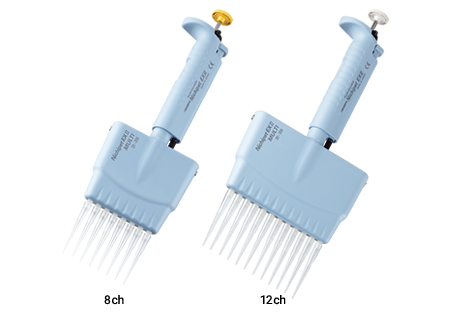
The following product pages provide useful 8- and 12-channel configurations for laboratories planning 96-well workflows. They are presented as purchasing options to discuss rather than in-stock recommendations.
|
Product |
Plate orientation |
Listed volume configurations |
Selected catalog numbers |
Purchasing route |
|
One eight-well column at a time |
0.5–10, 10–100, 20–200 and 30–300 µL |
00-NAR-10M8, 00-NAR-100M8, 00-NAR-200M8, 00-NAR-300M8 |
Request restocking or an alternative |
|
|
One 12-well row at a time |
0.5–10, 10–100, 20–200 and 30–300 µL |
00-NAR-10M12, 00-NAR-100M12, 00-NAR-200M12, 00-NAR-300M12 |
Request restocking or an alternative |
The listed features include a slim ergonomic body, reduced stroke load compared with earlier models, smooth volume setting, a multi-fit nozzle and full autoclave compatibility. Buyers should confirm the latest specifications, compatible tips and required volume configuration before finalizing a selection. Ordering note: The listed Nichipet Air Multi 8- and 12-channel pipettes may currently be unavailable online. Contact Astor Scientific to confirm restocking, the required volume range, lead time or a compatible alternative.
Request Restocking or a Compatible Multichannel Pipette
How Pipette Channels Match a 96-Well Plate
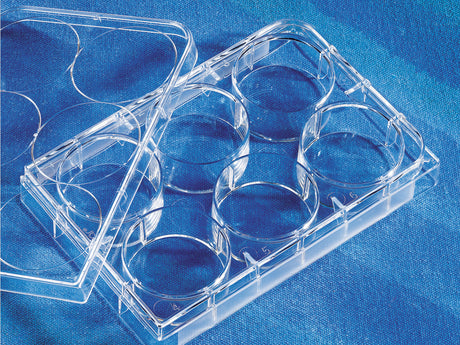
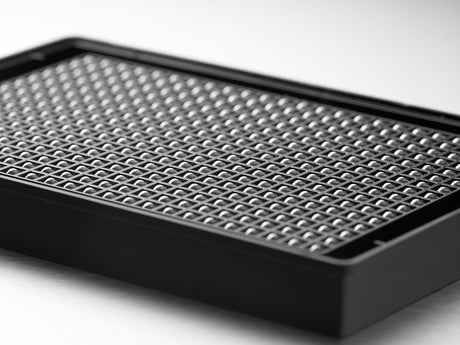
A standard 96-well plate contains eight rows labeled A through H and 12 columns numbered 1 through 12. This layout explains the value of the two common multichannel formats:
- An 8-channel pipette can address one complete column at a time.
- A 12-channel pipette can address one complete row at a time.
- A single-channel pipette addresses one well at a time.
An 8-channel instrument can fill a complete plate in 12 positions, while a 12-channel instrument can cover it in eight positions. Actual speed depends on the liquid, tip loading, reservoir design, mixing, operator technique and number of pauses required by the protocol.

Single-Channel vs Multichannel Pipettes
|
Buying factor |
Single-channel pipette |
Multichannel pipette |
|
Flexibility |
Excellent for any well or irregular plate map |
Best for repeated transfers in aligned rows or columns |
|
Throughput |
Slower for full-plate dispensing |
Faster for repeated equal-volume transfers |
|
Standards and controls |
Easy to place individually |
Useful only when the plate plan aligns with the channels |
|
Serial dilutions |
Flexible for custom dilution patterns |
Efficient when the dilution scheme is designed for it |
|
Operator workload |
More repeated aspiration and dispensing |
Fewer repeated cycles per plate |
|
Tip use |
One tip per transfer position |
Eight or 12 tips loaded together |
|
Maintenance |
One piston and channel to monitor |
Every channel must seal and deliver consistently |
|
Purchase cost |
Usually lower for one instrument |
Higher initial cost but potentially greater throughput |
|
Best use |
Setup, corrections and irregular layouts |
Reagent addition, replication and multi-plate work |
When a Single-Channel Pipette Is the Better Choice
A single-channel pipette is practical when wells receive different solutions or volumes, particularly for standards, controls, limited samples and corrections.
Choose a single-channel direction when:
- The experiment uses an irregular plate layout.
- Only a few wells require liquid transfer.
- Standards or samples need different dilutions.
- The workflow includes frequent volume changes.
- Individual wells require mixing or correction.
- The available sample volume is limited.
Even high-throughput laboratories benefit from keeping suitable single-channel ranges at the workstation.
When a Multichannel Pipette Is the Better Choice
A multichannel pipette is valuable when the same liquid must be dispensed across much of the plate, including diluent, substrate, stop solution, master mix, stain or medium. One cycle can serve eight or 12 wells, reducing repetitive movements and timing differences across the plate.
Choose a multichannel direction when:
- Most wells receive the same volume.
- Several rows or columns must be processed.
- Multiple plates are run per day.
- Timing consistency across wells matters.
- Repetitive pipetting contributes to operator fatigue.
- The plate map is designed around aligned transfers.
8-Channel vs 12-Channel Pipettes
The better channel count depends on plate orientation and workflow design rather than speed alone.
Choose an 8-Channel Format When
- Samples or standards are organized by column.
- Each column represents one condition or sample group.
- The protocol progresses through columns 1 to 12.
- The reservoir and workstation layout suit column-based movement.
- The laboratory also handles strip tubes arranged in groups of eight.
Choose a 12-Channel Format When
- Reagents are dispensed one full row at a time.
- The experiment is organized across columns within each row.
- Covering the plate in eight positions is operationally convenient.
- The protocol uses row-oriented replication.
Neither format is universally better. Review an existing plate map and observe how the operator naturally moves through it before selecting a channel count.
Seven Buying Factors to Compare
1. Working Volume Range
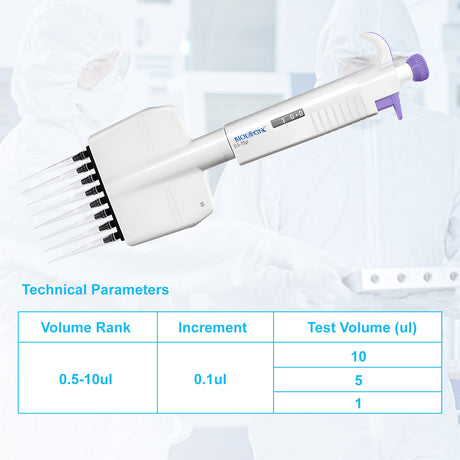
Select a pipette whose normal working range covers the volumes used most frequently. Do not choose only by the maximum setting. A model optimized around the routine transfer volume can be easier to use consistently than one regularly operated at its lowest limit. Many 96-well workflows need more than one range. PCR setup may require low-microliter transfers, while ELISA diluent, substrate or wash steps may use higher volumes. List every recurring volume before requesting a quote.
2. Accuracy and Precision
Accuracy describes closeness to the target volume; precision describes repeatability. Review specifications at volumes relevant to the assay—not only at maximum volume. Channel-to-channel consistency also matters. Calibration and functional checks should cover the complete multichannel system.
3. Tip Fit and Plate Compatibility
Tips must seal uniformly across every channel. An uneven fit can cause one channel to aspirate less liquid, drip or deliver inconsistently. Confirm the compatible tip family, volume, rack format and whether filtered, sterile or low-retention versions are required. Also confirm compatibility with deep-well plates, PCR plates, reservoirs or strip tubes used in the workflow.

4. Ergonomics and Ejection Force
High-throughput work places repeated load on the thumb, hand and wrist. Compare pipette weight, balance, plunger force, tip-loading pressure, ejector force and handle rotation. A heavier instrument may feel stable but become tiring across multiple plates. Ergonomic value should be evaluated with the tips and volume settings actually used. If possible, ask whether a demonstration or technical comparison is available before a multi-unit purchase.
5. Manual vs Electronic Operation
Manual multichannel pipettes offer straightforward control and generally lower initial cost. Electronic formats may add programmable aspiration, dispensing, mixing, repeat-dispense and speed settings. For electronic models, compare charging, service, training and programming needs alongside workflow benefits.
6. Sterilization and Contamination Control
For PCR, cell culture or contamination-sensitive assays, confirm whether the complete pipette or selected lower parts are autoclavable. Review permitted cycle conditions and post-autoclave calibration guidance. UV resistance should also be verified if the instrument will remain in a clean bench or PCR workstation. Filtered tips can help reduce aerosol movement into the pipette. Sterile tips support aseptic workflows, while low-retention surfaces may improve recovery of selected reagents. These features should be chosen by application rather than added automatically.
7. Calibration, Repair and Total Cost
Compare the instrument price together with tips, racks, calibration, spare parts, repairability and downtime. Multichannel pipettes may require more involved service because each piston and nozzle must function consistently. For recurring work, ask about compatible-tip supply, calibration documentation and service turnaround. A lower purchase price may not produce the lowest total cost if proprietary tips or difficult repairs interrupt routine plate processing.
Best Pipette Setup by Application
|
Application |
Practical setup to evaluate |
|
ELISA |
Single channel for standards and samples; multichannel for diluent, detection reagents, substrate and stop solution |
|
PCR or qPCR |
Single channel for sensitive setup; multichannel for master mix or template loading when the plate map aligns |
|
Cell-based assays |
Multichannel for media, stains or treatment addition; single channel for unique conditions |
|
Serial dilution plates |
Single channel for custom patterns or multichannel for a validated aligned dilution scheme |
|
Screening assays |
Multichannel or electronic format for repeat dispensing; single channel for controls and corrections |
|
Low-throughput research |
Single channel may provide enough flexibility without unnecessary equipment cost |
Planning a Multi-Pipette or Laboratory-Wide Order
Create a volume and workflow map before requesting pricing. Include the number of users, plates per day, required channel counts, transfer volumes, tip formats, sterilization needs and calibration documentation. Many laboratories benefit from purchasing complementary ranges rather than identical units. A low-volume single-channel pipette, a higher-volume single-channel pipette and one suitable multichannel range can cover more plate steps than one instrument alone.
Ask for current ordering options, lead time, compatible-tip information, calibration support and project pricing. For recurring tip requirements, estimate monthly rack consumption so the supply plan covers both instruments and consumables.
FAQs
Is a single-channel or multichannel pipette better for 96-well plates?
A multichannel pipette is typically more efficient for repeated equal-volume transfers, while a single-channel pipette is better for standards, controls and irregular plate layouts. Many workflows benefit from both.
Should I buy an 8-channel or 12-channel pipette?
Choose an 8-channel format for column-based work and a 12-channel format for row-based work. Base the decision on the plate map and operator workflow.
How many positions are needed to fill a 96-well plate?
An 8-channel pipette addresses the plate in 12 column positions. A 12-channel pipette addresses it in eight row positions.
What volume range is best for ELISA plates?
It depends on the protocol. Standards may require lower volumes, while reagents can require higher volumes. Match the pipette range to the volumes used most often.
Choose the Best Pipette for Your 96-Well Workflow
Start with the plate map, channel orientation and routine transfer volumes. Then compare accuracy, channel consistency, compatible tips, ergonomics, sterilization, calibration and total ownership cost.
For product-selection support, share the application, single- or multichannel preference, volume range, daily plate count, required tip type and documentation needs. Astor Scientific can help identify a compatible current ordering option and prepare project pricing for instruments and recurring tips.